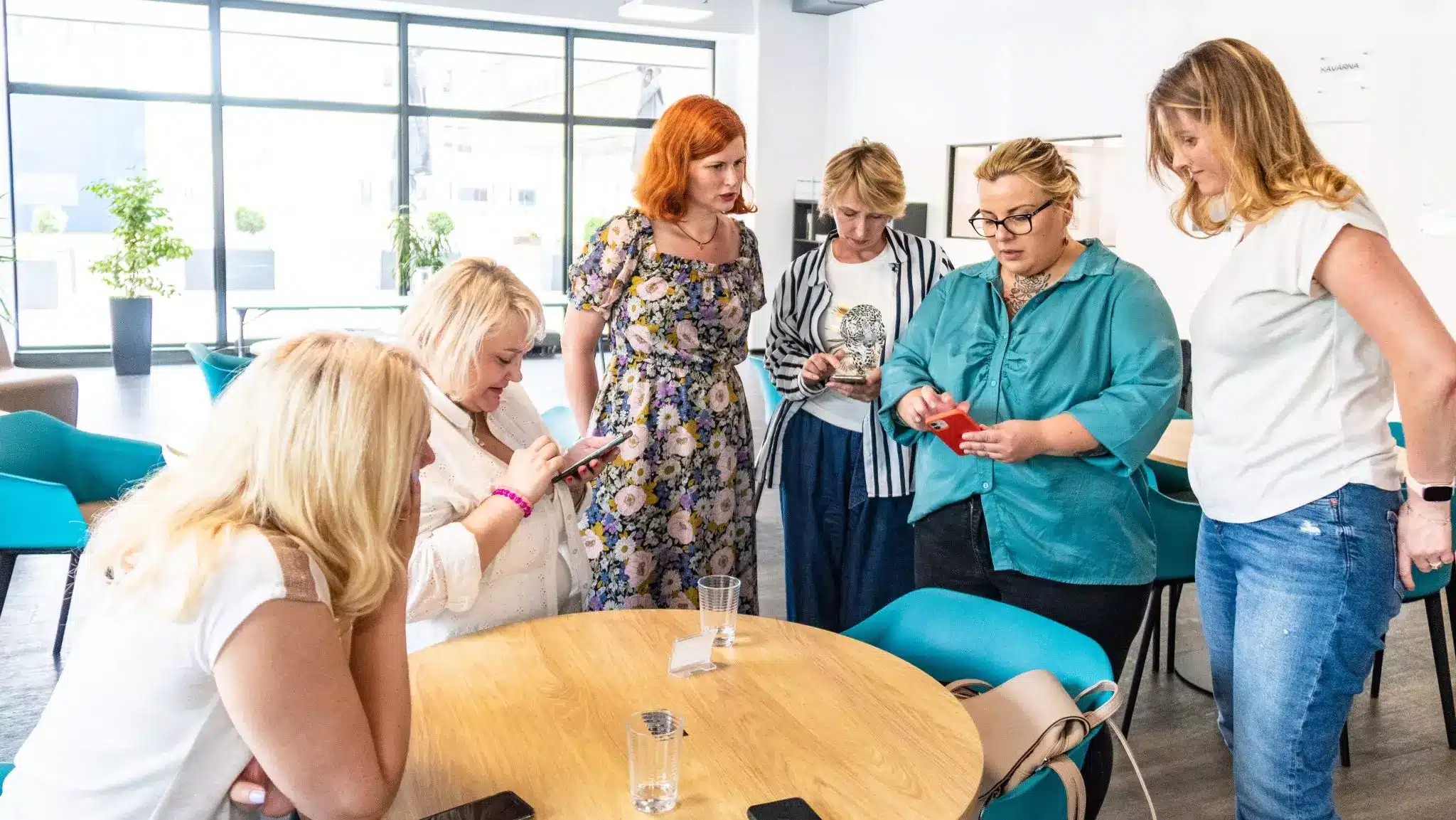
Just settling in a foreign city is often a difficult task. What must it be like to settle in a foreign country or on a completely different continent? And when you add starting a business to settling in, it becomes the perfect room for mistakes. And if you really don't want something, then solve the problem with legislation in a foreign country, where you have no contacts, knowledge and are just getting to know the rules. This is exactly the problem that our project helps with business incubator ICUK. UNITIO.CZ is a business club for expats, which was one of the first to use ours new SPOINT services. We interviewed the founder of the project, Kateřina Myška Zolotnicyn, right before their workshop for expats, i.e. foreigners living in the Czech Republic for a long time.
Kateřina, how did you come to start a business club for expats in our region - UNITIO.cz?
The idea was born gradually. When interpreting for the Regional Assistance Center for Help to Ukraine, we were often contacted by people with requests for advice in the field of business in the Czech Republic. This need was partially fulfilled by some non-profit organizations in the region, but with the influx of refugees from Ukraine and migrants from other countries, they could not sufficiently satisfy it due to capacity reasons and often due to the provision of primarily social services as part of the integration of foreigners in the Czech Republic. That's why my colleague and I developed the idea of helping start a business for all Russian-speaking foreigners (for now) who are looking for comprehensive and free information for setting up a business or company with all the important details according to the field of business (certification, concessions, health and safety, etc.).
I can't help but touch on that topic given what's happening in Ukraine. You yourself are from Russia. Isn't it an obstacle for the Ukrainians you have in the incubator?
I have not yet come across a case where one of the parties would be uncomfortable working together solely on the basis of ethnicity or nationality. My family had their own reasons for leaving Russia in the 1990s, which remain to this day. And I'm glad that thanks to our project I can get to know other Russians who are not indifferent to the war in Ukraine and who want to help as their strength and situation allows.
How does such an incubator for expats actually work? Is it the same as our business incubator?
On the one hand, yes – we still deal with the business plan, we deal with marketing promotion, the lifespan of business ideas, and other things that any other entrepreneur is forced to deal with. On the other hand, however, we must pay close attention to situations that may seem obvious to Czech entrepreneurs. For example, we often deal with the topics of levies, legal standards regulated by the Trades Act, the process of submitting a tax return and all administrative requirements related to business, of which the Czech entrepreneur has at least some knowledge or is able to find this information in Czech.
And what is it like to be with an incubator in an incubator?
It's great and I sincerely hope that our cooperation will not end at the end of the incubator at ICUK. I would be very happy if one day, through us or other helping organizations, budding entrepreneurs from among foreigners could enter the ICUK incubator with their ideas.
How many projects do you have in the incubator now, and who primarily makes up the community?
We cooperate with each project in a different way, according to the needs of the given start-up entrepreneur. Some require individual care (for example, multiple individual consultations), and some require, for example, one workshop on a given topic. In terms of numbers, so far there are roughly 10-15 starting entrepreneurs. About 80 % of them are people granted temporary protection who came to the Czech Republic after the outbreak of the war in Ukraine. The rest are Russian-speaking foreigners who live here with a different residence status, or even people who are among foreigners and have already been granted permanent residence.


What is the most common problem for expats when they want to start their business in our region?
Orientation in the legal system related to business, the language barrier and the general fear of the unknown.
And from your point of view - do we have simpler legislation for doing business in the Czech Republic or is bureaucracy the biggest obstacle for expats?
It depends where the foreigner comes from. However, in general I can say that it is not more complicated, it is just different than what they are used to. Quite often they are surprised by the number of tax obligations, but also by possible tax reliefs. In short, our system is something new for foreigners that they want to understand and adapt to.
I will come back to the progress of your incubator. Looking for experts in a given field and in a foreign language is probably a piece of cake, isn't it? Or am I mistaken?
It's not easy at all! Given that we move in a foreign community and like to meet new people with my colleague, we quite often come across experts in various fields. It even sometimes happens to us that they themselves approach us after the workshop with an offer of cooperation in the next workshop.
The innovation center recently opened SPoint - a social business consultancy. How important is this place to you?
Fundamentally. Thanks to the help and support we received in such a short period of time from the people of SPoint, we had the opportunity to start thinking about our project as a social enterprise. We receive a large amount of information and feedback, and thanks to this we can start building a social business where we can employ migrants and at the same time help migrants with our activities, which we had no idea was even possible. Big thanks to ICUK and its SPoint service for that! I can even reveal that after publishing information about SPoint in the Russian-speaking community of foreigners, a wave of interest in social entrepreneurship is starting to rise among them as well, and we are happy to direct them to you.
Can you tell us about your plans for the future?
Definitely continue what we are doing now and develop in this direction. On the agenda is mainly a stable background of the organization, which we are now actively looking for, the employment of foreigners in our team and the effort to ensure that the organization is able to earn on its own with other services that we offer not only for foreigners - website, CRM systems, UX/UI audit and marketing services.
Katerina, we wish you success and lots of strength to the next business.