| Success stories
ROWINGO: Winning Startup Go Grill was a great satisfaction

Matouš, congratulations once again for winning the Startup Go Grill 2022 competition. To begin with, tell us how you got into building a rowing simulator startup?
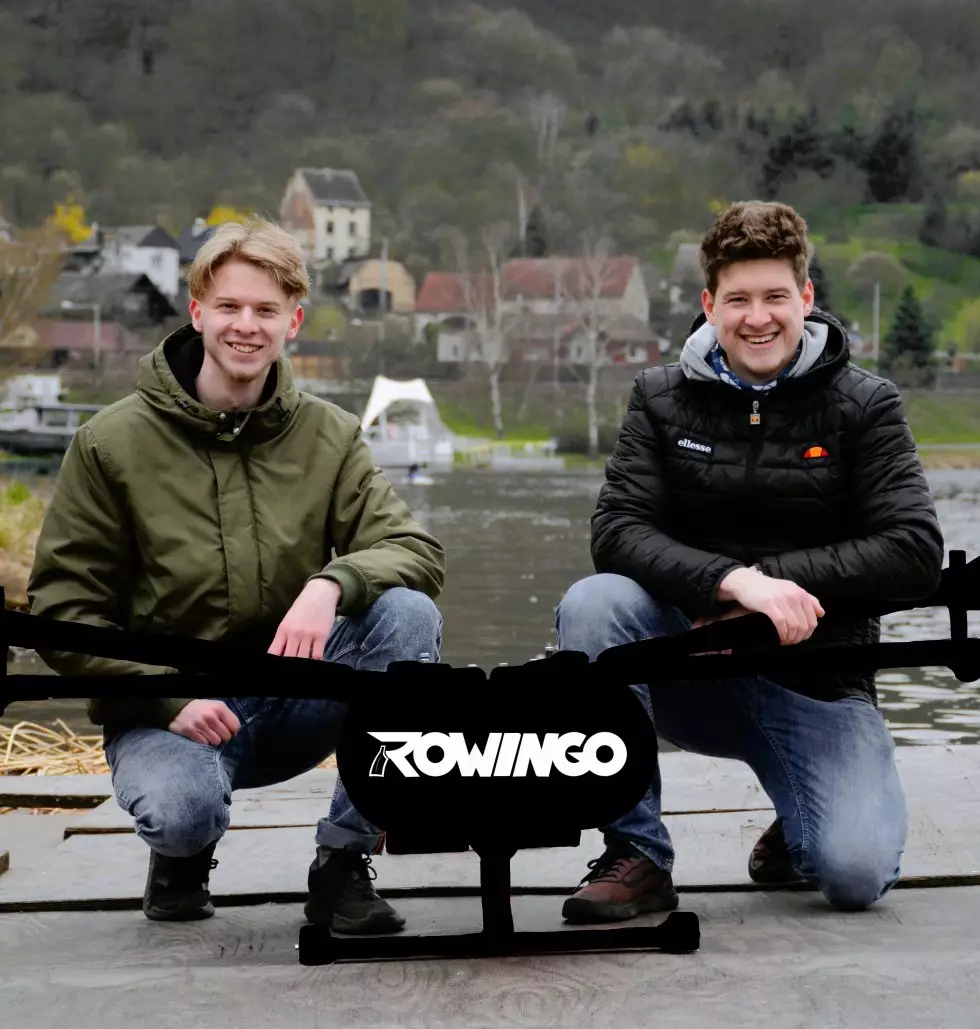
Thanks for the whole team. It all started with the dissatisfaction I experienced with rowing training on classic machines. Today's rowing machines lack oars even in the 21st century. And without oars, the important technique of rowing movement is lost, which must be learned again after winter preparation (on machines).
I was looking for better rowing simulators, unfortunately the ones that are still sold today are as expensive as racing boats, i.e. 150 to 250 thousand crowns. I wrote the ideas on paper, we put our heads together with my rowing colleague Honza and together we sketched the basics of Rowingo. Of course, we started with a survey of potential customers. We were excited to verify that we are not the only ones with a problem with the absence of oars. We contacted our friend David, who at the time was studying at a mechanical engineering school in Ústí, and we got to work.
So no one before you thought of solving this problem by adding oars to the trainer?
It's not the only problem, but it's definitely a major one. So our simulator has oars, so the oarsman can allow himself to develop the entire movement with his hands as on a boat. However, we are trying to solve more problems of today's machines. Rowing is a complex, but amazing movement that engages the whole body. Therefore, in the future, we would like our machine to teach athletes who have never rowed this great movement through an interactive application to monitor the correct movement technique and prepared training plans.
Initially, each machine will connect to an app on the rider's phone and record ride data that can be shared with coaches. I believe that in ten years we will definitely have a connection to virtual reality, so you will be able to ride on any lake in the world while sweating in the gym.
The main draw compared to our competition will be the price of our simulator, because we plan to sell it for 50,000 crowns, which is the upper limit for today's rowing machines.
With your project, you rank among hardware startups. Which is actually atypical, since most startups are software. Do you see it as a positive or a negative, for example, when communicating with investors?
I wouldn't say that most startups are software, rather hardware startups are not talked about that much, which makes me a little sad. At the same time, I think that creating a software startup is easier due to the lower demands on, for example, work spaces. Our biggest problem is having to work in a metalworking shop when creating prototypes. On the contrary, when we design an app, we do it from the comfort of a coffee shop. We must also address factors of production. This is something that investors have been most interested in so far, besides the demand, whether we can fulfill it.
How do you evaluate the entire program retrospectively after completing it?
The incubator was a great help to us. We had a prototype at the beginning, but thanks to the incubator we are now able to stand in front of investors with a clear vision and numbers. We lacked a few soft skills, as a way to show how far we could go in sales. And not only that. Now we can even say what it will cost us along the way. Without the incubator, it would be much slower. Networking was also a big advantage. When we needed an expert or a company specializing in consultation, we always got a contact from Honza. Now the incubator for software projects is done, we as a hardware startup would appreciate some workshop and material, but we can never have everything. Maybe it's room for development.
We also miss that, on the other hand, ICUK has arranged for you to cooperate with the Faculty of Mechanical Engineering of UJEP, in whose laboratories and workshops you can use their equipment and work on the production of your prototype. Is that so?
That's true and it's something that will move us a long way forward again. I hope that other hardware projects will have a similar opportunity in the future. Big thanks to you and FSI for this.
Can you share with us an "AHA" moment from the workshops that changed your perspective on something?
Very happy. I am a typical user of the so-called Musk time. Elon Musk's employees gave this term to his time assumptions, they say it is 4 to 8 times more than normal time. So, at the beginning of Rowingo, I thought that we would be done within a year, now we are working on the third year and we are not stopping. During the incubator, I figured out that I implement this estimation tactic for money as well. When it came to determining the amount of investment needed, I thought that two million would be enough for us. After adding up all the investment and fixed costs, reserves and so on, we end up needing more than five. I see!
You stood your ground in the Startup Go Grill competition in front of a jury made up of investors, but also in front of the general public, and in competition with other projects that presented with you. What does that mean for you?
In the beginning, we had to bargain with our parents about working on a startup on the weekend instead of studying. Now after three years of hard work, we finally got satisfaction. Not only we believe in the project, but also the parents and the jury of investors. We are very happy for this award, we hope it will help us in further communication with investors.
Where will your next steps lead?
First of all, we need to find an investor for Rowingo. We also have feedback from Great Britain that our machine is needed. We will have a patent application filed during the summer, after which we will be able to start revealing photos of our machine to the world and gather feedback from across the ocean. At the same time, we are preparing a second prototype, with which we will start touring rowing races and give people the opportunity to test the machine.