| Success stories
Martin Richter: ChatGPT is an unexpected wake-up call for creative professions
Martin, what should we imagine under the term Creative Education?
Creative education has a clear definition, which says that it is a process that promotes the development of cognitive, social and emotional abilities through cultural and artistic activities. In my opinion, these are ways of learning that give us the freedom to create, develop, think outside the bounds and collaborate on complex tasks. In our view, it is specifically interactive work with generative artificial intelligence that connects art, technology and societal ethical issues.
What was your journey into artificial intelligence and why did you start AIGNOS?
It will sound like a cliché, but my relationship to artificial intelligence was greatly influenced by Karel Čapek. In 2021, to celebrate the centenary of the launch of Čapkov RUR, the Robothon - Hack the Machine and Save Humanity was held, where I met my current colleague Ondřej Hrách. We further developed the idea of creating educational materials from Robothon at the Kick Prague innovation marathon, which we used for the first piloting and feedback. As we won three jury awards and positive feedback, we had confirmation that we were heading in the right direction.
At AIGNOS, you organize workshops, for example, for primary schools on the topic of digital literacy, critical thinking and creativity. Can you tell us more about what such a workshop for young students looks like?
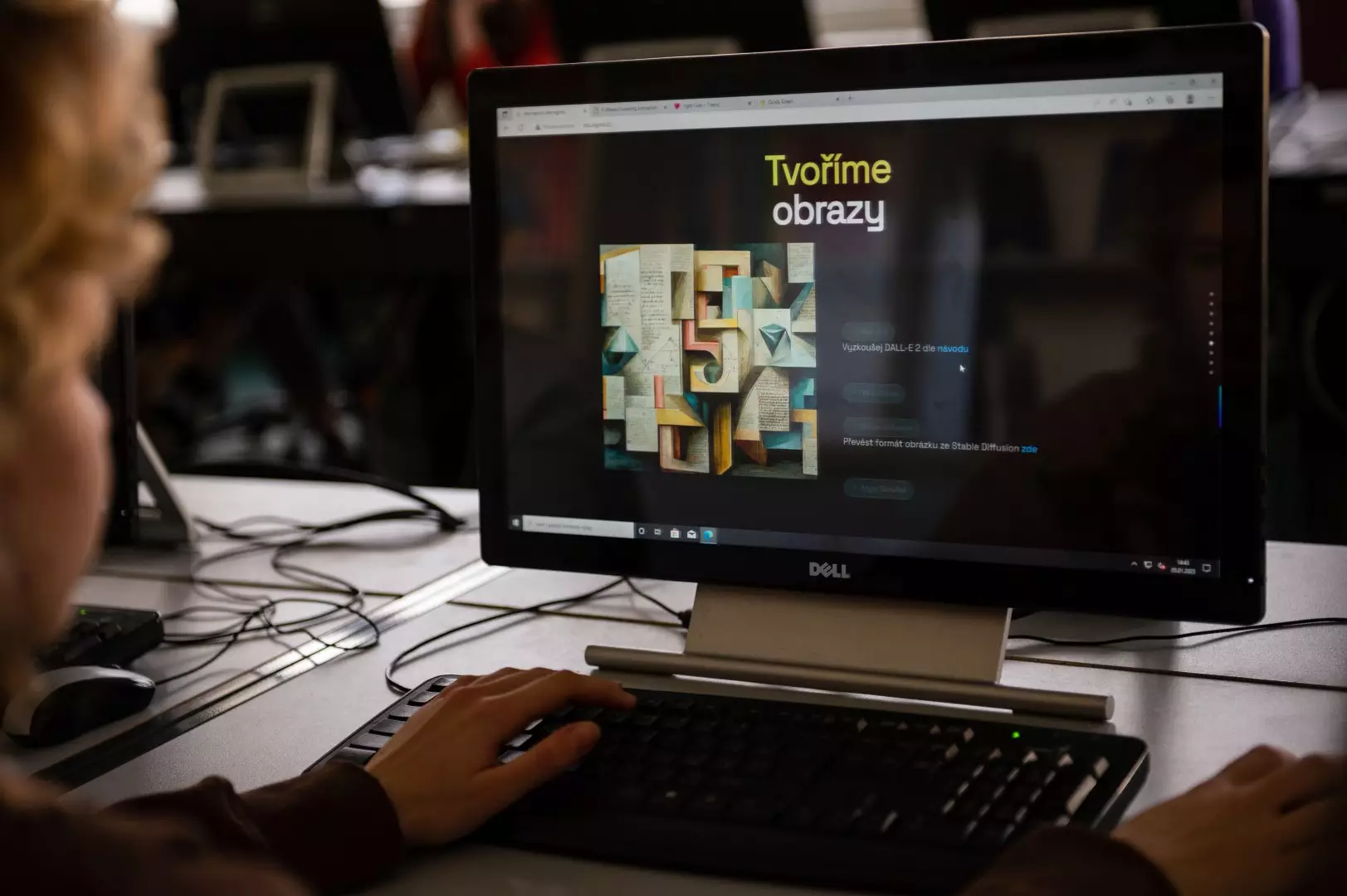
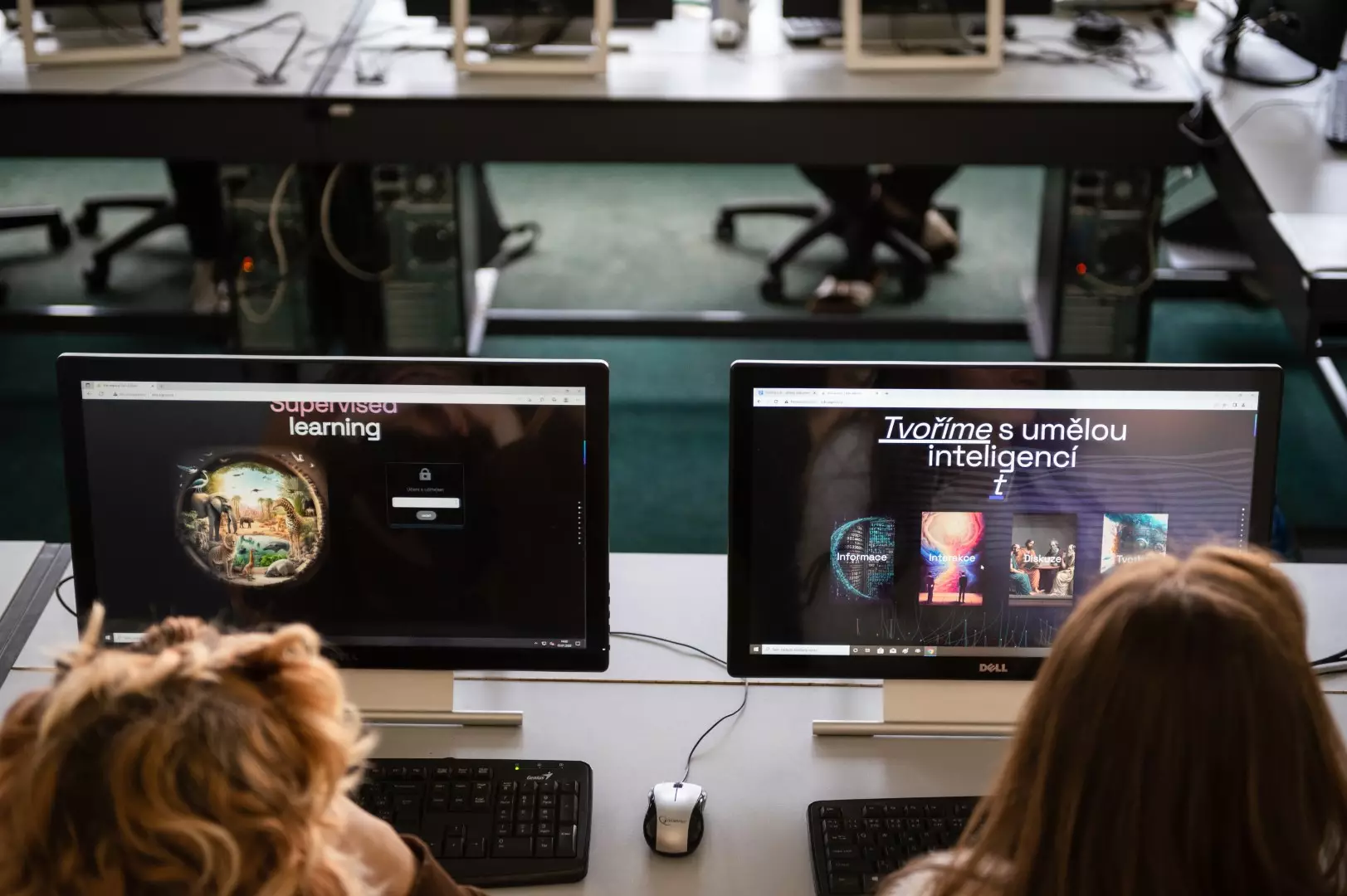
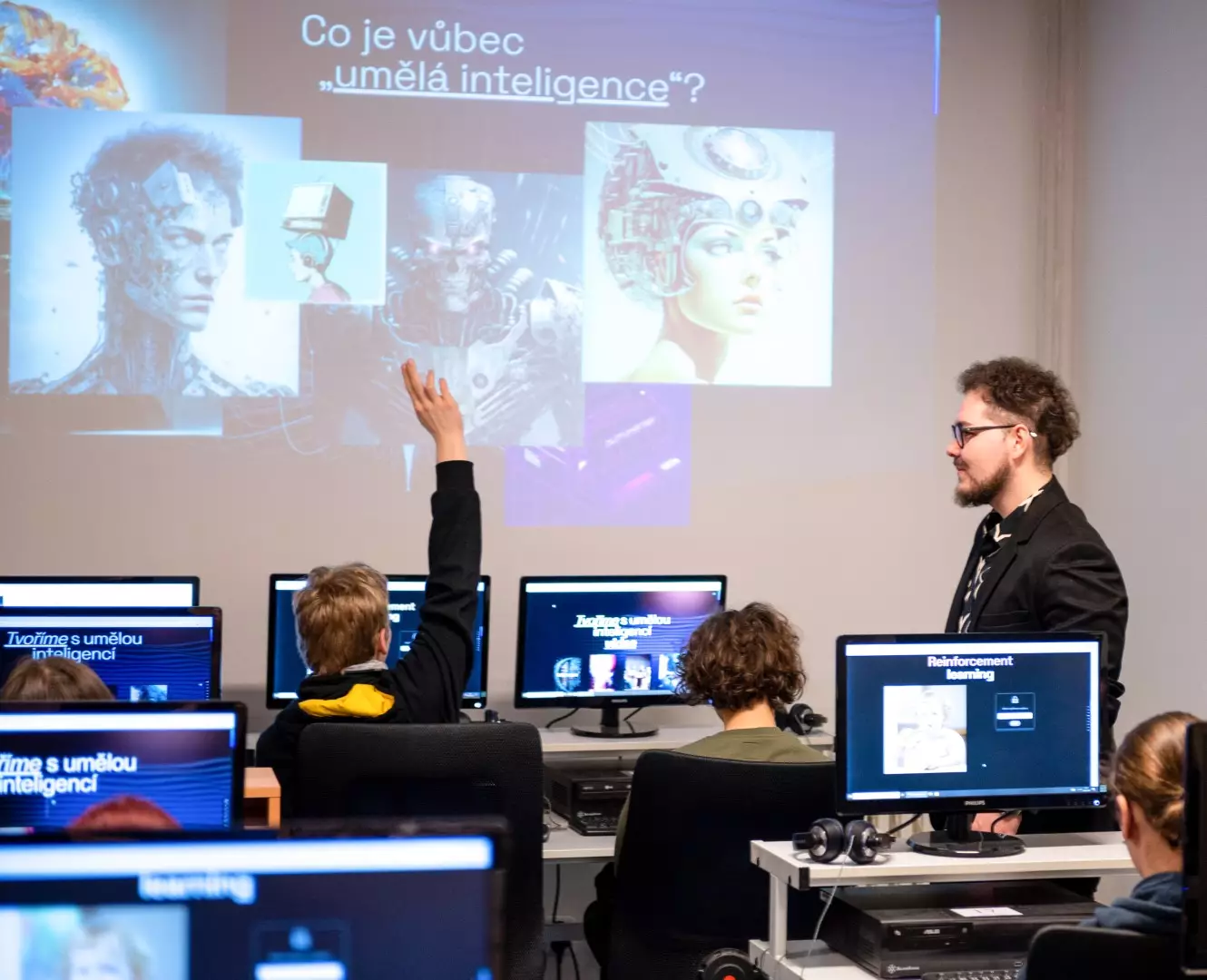
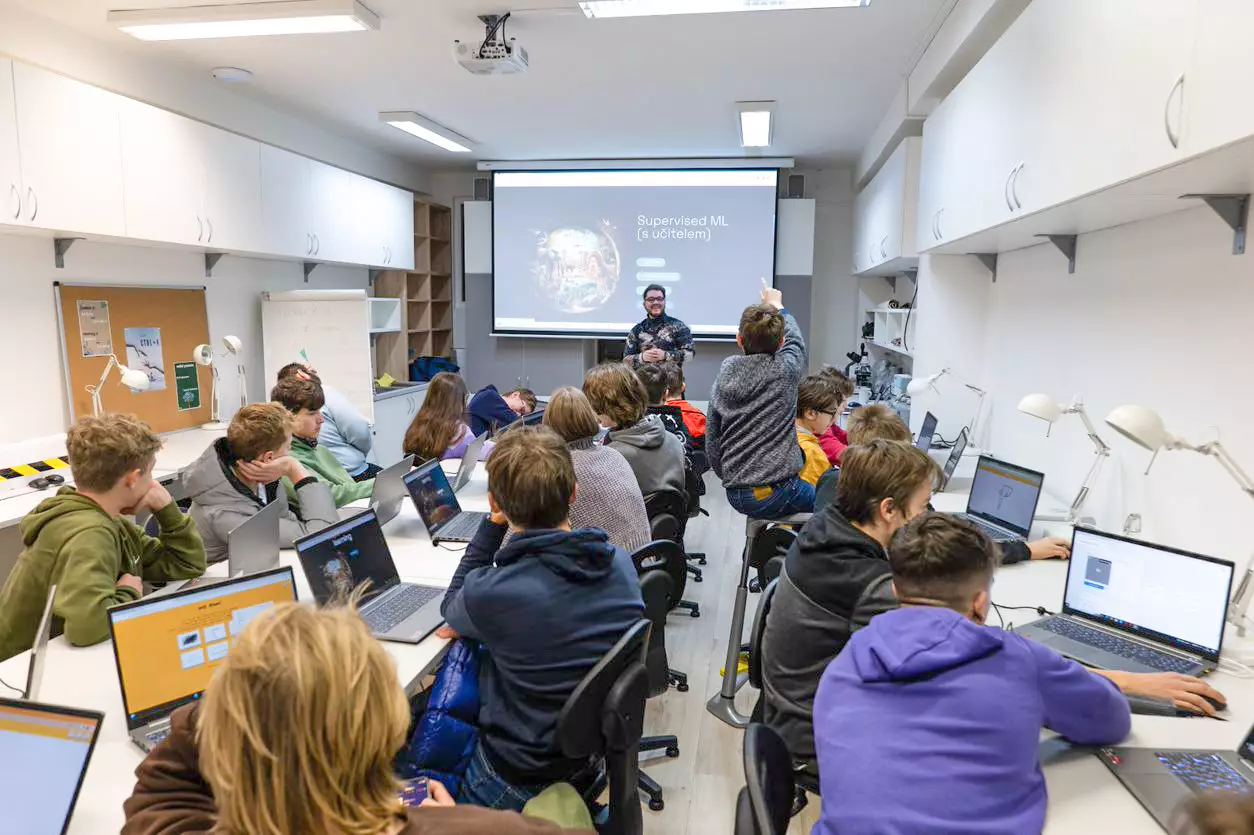
Currently, we are primarily devoted to the concept "We create with artificial intelligence", during which pupils of the eighth and ninth grades and high schools get to know the possibilities of generative AI. During the four-hour educational workshops, they will find out what principles AI works on, where they can meet it and what opportunities it offers for their own creativity. In cooperation with various applications (ChatGPT, Midjourney, THEaiTRE, Dalle-2...), everyone can try to write a short story or a theme for a play, compose music or create completely original paintings. All interactive tasks are available to workshop participants in a clear web application that was specially developed for this purpose. Another activity that students will try out in the workshops is interaction with digital personas. As part of supporting critical thinking, for example, they can chat with a fictitious AI presidential candidate. Of course, the emphasis is on creativity and the development of new creative skills. The entire four-hour program ends with the creation of one's own creative projects - the best ones will be presented at an interactive exhibition at the end of the school year.
Let's stay with the students. During the summer academy Skills for the future, you educated the participants on topics such as social networks, digital identity or technological well-being. From your experience, how do the emerging generation who grew up on social networks and often find digital detox unrealistic, look at these topics?
Thanks to the support of the Ministry of Culture, we can visit schools throughout the country this school year, which offers us a slightly broader picture. Our screening shows that the majority of young people think that they should pay more attention to modern technologies in school teaching, which is also confirmed by my personal experience. Pupils know quite a few concepts, but they do not have them anchored in the context. When we talk about algorithmic content recommendation, personalized social network feed at workshops in the context of machine learning, quite a few "aha-moments" arise. It can be seen that I am somewhat aware of the risks associated with technology and artificial intelligence, but lack comprehensive information and critical insight into how they work. This is exactly what we are trying to change with our project.
You are also behind the project - Artur Robotnik, which is the president created by artificial intelligence. Was this step a marketing move or should we prepare for such a future?
Neither (laughs). We use our digital persona of a fictitious presidential candidate for educational purposes. It is a great opportunity to concretely illustrate the opportunities and limitations of generative artificial intelligence and conversational systems. We certainly don't think an AI president would be a better candidate than a human. We want to talk about artificial intelligence with young people in different contexts, so we used the persona of the presidential candidate, who is very current. But we also work with other persons, which we will gradually introduce. However, Artur and I don't just go to schools. We also attend technology conferences, modern DIY fairs and debates of presidential candidates. So I have to admit that the "AI president" at these events in a certain sense functions as a communication shorthand for our AI educational projects.
I also have a philosophical question here – what shapes our relationship to AI? Why do some people imagine a terminator, and others see it as an opportunity, for example, to make medicine more efficient?
People naturally side with either techno-optimists or techno-skeptics. These natural tendencies are always amplified by one's own technological experience, but pop culture and clickbait headlines in the media also have an influence.
For what purposes do you personally use OpenAI's Chat GPT3 tool? (I assume you are using it).
As a designer, I use a wide range of generative AI tools that help me mainly with ideation and the creative process. After the GPT3 generator, ChatGPT is a bit better and is starting to look like a full-fledged copywriting tool that can be used for copy itself, consulting ideas, creating prompts for image generators, and searching for various technical solutions. It's fascinating... Of course, there are many more possibilities of use, but it is important to evaluate whether the individual functions can be included in a classic work flow, because otherwise there is a risk that a person will be stuck in awe at ChatuGPT for a few hours, but the work is still not done ( laughter).
And with current experience from this tool - will creatives or people in manufacturing companies lose their jobs sooner? (relief question)
A few years ago, the general consensus was that creative professions would be irreplaceable, and the threat of automation was met with raised eyebrows in these fields. Now came a (completely unexpected for many) "wake up call". However, it is still a tool that will not take away our work by itself. It will be taken from us by a person who can master these tools.
What awaits you now in the coming days?
In the coming weeks, my fellow lecturers and I will go to workshops for students and to teacher meetings. At the same time, we are still evaluating feedback from students, pedagogues, lecturers and our guarantors, so minor revisions of our application await us. Last but not least, we will be preparing an exhibition of student AI projects, which will be accompanied by an art competition and will take place at the end of the school year.
Martin, thank you for your time and we wish you lots of energy.